How Proper Outdoor Lighting Around Your Northeastern Pennsylvania Home Reduces the Risk of Trips and Falls After Dark
You probably do not think about the outdoor lighting around your home until something happens. A guest catches their foot on an uneven step coming up to your front door. You miss the edge of your porch after bringing in groceries after dark. A family member navigates your driveway in the winter and slips on a patch of ice that the dim porch light simply did not reach. These are not freak accidents. They are predictable outcomes of inadequate outdoor lighting around a residential property.
In Northeastern Pennsylvania where fall and winter months push sunset earlier and earlier and where ice, wet leaves, and uneven terrain are seasonal realities, the outdoor lighting around your home is not just about appearance. It is a direct safety measure that determines whether the people walking across your property after dark can see what they are stepping on.
Why Outdoor Lighting and Trip and Fall Risk Are Directly Connected
The connection between outdoor lighting and trip and fall accidents is not a matter of opinion. It is a documented safety relationship that building codes, insurance guidelines, and safety organizations all recognize.
Effective outdoor lighting aids in accident prevention. Pathways, driveways, and steps can present hazards in the dark. Proper illumination in these areas helps ensure that residents and visitors can safely navigate the property. This is especially important for avoiding trips and falls which can lead to serious injuries.
Inadequate lighting can pose significant fall risks by compromising visibility and increasing tripping hazards. Improvement of lighting levels requires changes in design that optimize ambient light and include sufficient lighting infrastructure.
Government and insurance safety guidelines often group exterior lighting alongside handrails and non-slip surfaces as basic measures to reduce injuries around the home.
For NEPA homeowners the seasonal dimension of this risk matters significantly. Northeastern Pennsylvania experiences conditions across fall and winter that make inadequate outdoor lighting especially dangerous. Wet leaves on walkways in October. Ice on steps and driveways from November through March. Earlier sunsets that push routine activities like arriving home from work, bringing in groceries, and taking out trash into darkness at times when they would happen in full daylight during other seasons.
The Areas of Your NEPA Home That Carry the Highest Trip and Fall Risk After Dark
Not every area of your property carries equal risk. Understanding where the highest hazard points are helps you prioritize where proper lighting makes the most difference.
Front steps and entry points
Your front steps are statistically the highest risk area for trips and falls on any residential property. They involve a change in elevation that requires precise foot placement. In low light conditions the edge of each step becomes invisible before the foot reaches it. The result is a misstep that happens in a fraction of a second with no time to recover.
Install pathway lights along walkways, driveways and steps. These lights guide the way for residents and guests reducing the risk of trips and falls. They also illuminate any potential obstacles or hazards.
Driveways and garage approaches
Your driveway is a long surface that transitions from the street to your home across a span that may include changes in grade, drainage channels, expansion joints, and surface variations that are completely invisible in darkness. If your garage is detached or set back from the house the path between your car and your door crosses an area that most homeowners never light adequately.
In NEPA winters that driveway surface develops ice in areas that are shaded during the day and never reach thawing temperatures. Those ice patches are completely invisible under poor lighting conditions. A homeowner who has walked the same driveway thousands of times in daylight has no muscle memory that accounts for a patch of black ice under a tree line that does not catch any light from the porch.
Side yard pathways and gates
Side yards are the most consistently underlighted area on NEPA residential properties. They are narrow spaces that connect the front and back of the property and they carry significant foot traffic for garbage bins, garden tools, HVAC equipment access, and everyday movement around the property. They almost never have dedicated lighting.
Trips, falls and other accidents often occur on poorly lit pathways where uneven surfaces or obstacles are difficult to detect. Outdoor step lights and pathway lights can illuminate staircases and trails ensuring safe navigation.
Back doors and rear entries
Back doors are common entry points. Make sure they are bright enough to cover the doorway and at least a few feet beyond. This helps visitors and you avoid trips and falls and removes dark approach routes.
Most NEPA homeowners use their back door as frequently or more frequently than their front door. The back door leads to the garage, the driveway, the yard, and the trash area. It is typically lit by a single wall-mounted fixture that illuminates the door itself but leaves the steps, the landing, and the approach in darkness.
Call Bee-lectric at (570) 325-5808 to schedule an outdoor lighting assessment for your Northeastern Pennsylvania home today.
What Proper Outdoor Lighting Installation Actually Looks Like for Your NEPA Home
Proper outdoor lighting for residential trips and fall prevention is not about putting a bright light in one location and assuming it covers everything. It is about layering light strategically so that every surface a person steps on after dark is illuminated from the right angle to reveal its edges, texture, and any hazards on it.
Pathway lighting
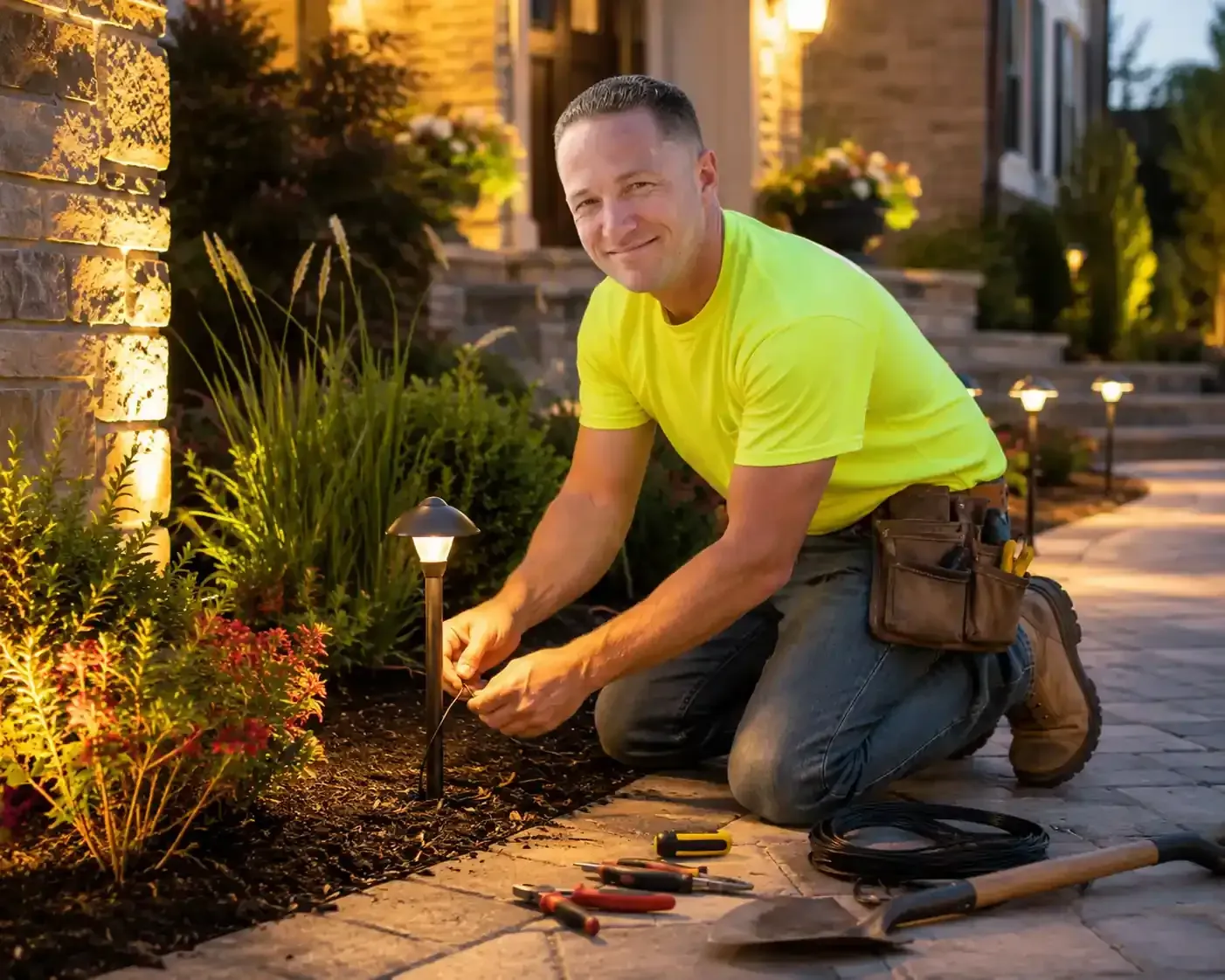
Pathway lights are low fixtures installed along both sides of a walkway that cast light downward onto the walking surface. They do not cast glare into the eyes of someone walking toward them. They illuminate the ground itself including any unevenness, obstacles, wet leaves, or ice that someone needs to see before their foot lands on it.
Step lighting
Step lights install directly into the riser of each step and cast light across the tread surface below. They eliminate the shadow that top-mounted fixtures create on step treads and make the edge of each step clearly visible from the approach angle. For NEPA homes with front steps, back steps, deck stairs, or any elevation change in the walkway or yard, step lighting is the single most effective trip prevention measure available.
Motion activated flood lighting for driveways and approaches
You do not need to flood your entire property with light. Focus on strategic zones. Use motion activated lights near all secondary entrances. Make sure they are bright enough to cover the doorway and at least a few feet beyond.
Motion activated flood lighting for driveways and garage approaches activates the moment you pull in or step out of your car. That immediate full illumination of the driveway surface is what reveals the ice patch, the tool left out, or the change in grade before your foot finds it in the dark.
Wall mounted fixtures at correct heights
Wall mounted fixtures at entry points need to be positioned and aimed to illuminate the approach and the steps, not just the door itself. A fixture mounted too high creates a pool of light on the porch surface but leaves the steps below in shadow. Correct fixture height and lens angle for wall-mounted entry lighting is something a licensed electrician assesses based on your specific porch configuration rather than just mounting a fixture at a standard height and calling it done.
What NEPA Winters Add to the Outdoor Lighting Safety Equation
Every trip and fall hazard that exists in your yard and driveway during dry fall conditions becomes significantly more dangerous once ice and snow arrive in Northeastern Pennsylvania.
Ice is invisible under poor lighting. A surface that looks like wet pavement under a dim fixture may be a sheet of ice that offers no traction. Proper lighting does not prevent ice from forming but it reveals it before someone steps onto it without knowing it is there. That fraction of a second of visual information is the difference between someone adjusting their step and someone falling.
What to Ask Before Scheduling Outdoor Lighting Installation for Your NEPA Home
Before any fixture goes on your property, confirm that your electrician is assessing every high traffic area and every elevation change on your property rather than just quoting a standard front porch and driveway package.
Ask how each fixture will be positioned relative to the surface it needs to illuminate. A fixture that illuminates from the wrong angle creates glare without revealing the surface texture that tells you where to step safely.
Ask what fixture ratings are specified for your climate. Outdoor lighting fixtures in Northeastern Pennsylvania need to be rated for wet locations and rated to withstand the thermal cycling between cold Pennsylvania winters and summer heat. Fixtures rated only for damp locations fail prematurely when ice and snow make direct contact with the housing.
A Well-Lit Home Is a Safer Home for Everyone on Your Property
The outdoor lighting around your Northeastern Pennsylvania home determines whether your family, your guests, and anyone else who walks across your property after dark can see where they are stepping. In a region where fall and winter conditions create genuine hazards on residential walkways, steps, and driveways for months at a time, visibility is not a luxury. It is a basic safety requirement.
Proper outdoor lighting installation addresses each hazard area with the right fixture type, the right positioning, and the right light level to reveal surface conditions before someone's foot finds a problem the hard way.
Call Bee-lectric at (570) 325-5808 to schedule your outdoor lighting assessment in Northeastern Pennsylvania today.